Showing posts with label trailing spouse. Show all posts

Wednesday, 5 June 2013

Patty's portrait


At our most recent Trailing Spouses' Art Group meeting Grace had set us the project of making a portrait of another member of the group. It was a follow up to a self portrait project where we had looked at themes of identity and sense of belonging as trailing spouses. This time, though, we would  focus on strengthening our connection to another member of the group by making a portrait of them. As Grace said in her mail out "as a trailing spouse there can be a feeling of being in between things, in limbo, not being tied to something. One of the best ways to shake off that in between feeling is to make a connection. It may seem exhausting to put in so much effort for a place that is only temporary. But in this age of internet, no connection is temporary anymore."

Grace provided us with a questionnaire as a starting point for a portrait, picked randomly the person we would create a portrait for and gave us free reign to use whatever materials we chose.

Patty, who has recently relocated back to the States, said that she chose two aspects to portray me, the fact that I play the trumpet and that I write a blog. Her idea was to recreate a pixelated style portrait  using rolled up slips of paper, printed with music manuscript and extracts from my blog posts. A dab of colour was added to each tip to depict the shadings and contours of a face.

A layered paper grid keeps the scrolls in place, a sense of order amongst the array of musical notation and words but then a dab of not quite neat colour on each scroll questions the sense of order again promised by the formal staves and fonts.

When you view it from the side it reveals a miniature landscape or city, the paper scrolls like towers. Like an invite to shrink yourself down and walk through it. As I enjoy walking through cities and urban spaces with a camera I like this idea of a place waiting to be discovered.

That the portrait doesn't work as a pixelated style image from above is more than fine for me. I don't tend to put photos of myself up on Facebook much or on my blog so I actually liked this ambiguous portrait derived from the photo on my twitter page.

Each of the tiny scrolls is around 3mm thick. I saw Patty at work at our last meeting deftly rolling each strip of paper with a quilling tool.  The grid measures just 8 cm x 8 cm.

Thank you Patty for this portrait of me. Just the thing to remind me of you and our art group here in Bielefeld.


Thursday, 23 May 2013

Quiet please! We're moving.

Quiet please! But I find this sign too loud!


Waiting books


Vertiginous reading


Imparting knowledge


Low profile


Background reading

These photos were taken at the University of Bielefeld Library in Germany. We moved to Bielefeld, a small town in the North of Germany, over four years ago because my partner got a job at the university. Academic contracts tend to be limited so a great deal of flexibility is called on the family. Having moved once from Berlin to Bielefeld, now that my partner's contract is up we are facing the challenge of relocation again.

In academia, you are expected to move around at the drop of a hat, indeed it is a requirement of a good CV in today's academic market. This is not something that goes together with having a stable family life. As a trailing spouse of an academic you may have to make sacrifices in your career, or build your career around a highly mobile lifestyle. For children, it means sacrificing long term friendships, and a familiarity brought about by putting down roots . Sometimes families in these situation face very hard decisions. Should the family be temporarily separated, while the academic partner takes up 1 year contracts abroad which have no guarantee of extension? Or should the family move and ride the course of uncertainty together. There is no way of knowing quite when a permanent contract or a professorship will finally arrive. Should the child's environmental/cultural stability take precedence over daily contact with the academic parent?

"Pendeln" in Germany is not uncommon, and describes the act travelling  back and forth from your family home to your place of work, usually over long distances. I know of an academic family in Germany where one partner is an professor and works during the week in Berlin and the other partner, also a professor, is based in Munich with the children. This involves "Pendeln" every weekend, a journey of around 6 hours each way by train. As Germany is a more federal country than the UK, i.e. centres of industries, media, banks are more evenly distributed amongst its cities, it means that people here are more used to the idea of "Pendeln". In Frankfurt, for example, there is the banking industry, in Hamburg the media industry. Everyone wants to live in Berlin, but there are not so many jobs available there. I know of many other examples of people living this lifestyle of "Pendeln".

Of course these are personal decisions and also depend on the individual child. Financially though, these short term contracts, like the one we have just been offered, are not automatically offered relocation support from the universities. These, rather, are awarded to Professorial or longer term posts, which doesn't mean that there isn't a spouse and children to consider and all the costs involved as in any other major move.

At the moment, I am negotiating this situation our family is facing step by step. We still haven't reached a decision. I found a moment of peace in the university library, despite the very loud "Quiet Please" sign. There are 2.2 million books in this library but I am afraid none of them can help with the decisions academic families like us are facing at the moment.

I am indebted to The Trailing Spouses Art group that Piia Rossi founded here in Bielefeld a few years ago. These meetings continue to inspire me in dealing with the ongoing challenges of being a trailing spouse in questions such as identity, language and career,  but in a supportive and creative environment.

Here you can see on youtube a Pechakucha presentation of the Trailing Spouses Art group by Piia and myself in English and German.


Thursday, 7 March 2013

SkypeMe!


I am going to a meeting tonight of the Trailing Spouses' Art Group where the theme is "Sacrifice and Gains" in reference to career sacrifices , which are often a necessity when relocating one's life according to another person's career trajectory. Cheryl, who is leading the meeting, asked us to make a word cloud using sourced material on this theme.

As my husband has just had to go to America for work reasons, for three months leaving me and the two boys behind in Germany, there are obvious sacrifices that we are all having to make. As we are relying on Skype to communicate as a family I decided to source my word cloud from instructions on Skype from the internet (see above). I can identify some of the sacrifices and gains in communication that Skype offers us in words like "mishaps", "private/public", "support", "clearly" that appear in the cloud.

The first attempt to Skype with my husband newly arrived in Washington DC was a disaster. I could see my husband but I couldn't hear anything. It was so frustrating. So I was holding up this sign, which said :


My husband's face was pixelated and kept on freezing. The freezing thing when your Skyping bugs me. You can be rambling on thinking the other person's lack of movement means they are being extremely attentive but in reality the screen has just got stuck and it will be only a couple of mins before the connection is lost altogether. It still can give you the feeling that their digital alter ego is being rather rude by ignoring you.

Not having a smart phone or ipad hasn't stopped me going to greater lengths to integrate Skype into our normal family life. I lugged my 19 inch computer to the dining table the other day so that we could all have dinner together, sort of.

Kids don't interact in the same way as adults so we have to be creative in getting them to sit in front of a screen. My son draws during our conversations and then shows his pictures to my husband while we talk.

In terms of the theme of the TS meeting "sacrifice and gains", while getting used to the new situation of being a temporary single mum, I am not really focusing on thinking about a career.  It is hard to imagine or plan one when we don't know where will be living in one year. And as for my husband, he has obviously had to sacrifice a lot to continue along his path in academia by not seeing his family.  Unfortunately the academic world is highly competitive. You have to take the chances you are given, or else you are out of it.  Being an academic today, as my friend once pointed out, is a bit like being a Diplomat (i.e. highly mobile) but without any of the perks!

 We can only hope that our present sacrifice is serving our future gain.


Tuesday, 30 October 2012

Home is where the heART is


"Home is where the heart is" the saying goes. But at the Trailing Spouses Art Collective, we have discovered this past year that "Home is also where the heART is"! We are a group of 13 women who have all come to live in Bielefeld in Germany because of our partners' work. The group, which was initiated by Finnish artist Piia Rossi, has allowed us to creatively explore issues facing trailing spouses: lack of community support, loss of identity, loss of former careers, relationship problems, bureaucracy jungles and difficulties of finding new childcare and schools for our children, for example. 
In our exhibition, Home is where the heART is, we show work produced over the year since our founding in October 2011. We transformed a utilitarian space at Bielefeld University into a cosy living room, using our own spare furniture and furnishings, literally inviting visitors into our home to have a coffee and home made biscuits whilst looking at the art work. We wanted to make the visitor them feel at home, but also ask them to question what home means for a trailing spouse.
suitcases and packing boxes as plinths


paper houses on the theme of Investment


Open suitcases placed upon moving boxes became plinths displaying projects such as the paper houses on the theme of Investment. This project asked the question: If you move to a new city, knowing in a few years you will have to move again to follow the work, how much love, money and energy can you invest in your home? I took my odd key collection, and made a rubbing of the keys which I printed on my "house".  One key was from Berlin, reminding me of my former life there. I have no idea which objects I will be able to take from my real house when we next move, which could be within the next year, destination unknown, depending on next job offer.


Another suitcase displayed the Trailing Spouse self portraits as paper dolls. Grace's doll was made up entirely from Ikea catalogue cuttings. Not very personal, but the practicalities of settling into a new city  sometimes prohibit that.  

Reka adds the finishing touches to exhibit


The photographic portrait series "Faceless"  looked at how identity is effected by arriving in a new place, not knowing anybody and not knowing the language. Patty's response was a photo called "Nobody wants to play with alien chicken".
Nobody want to play with alien Chicken 


Pieces were also hung from threads from the ceiling, hankies printed with our "mini sagas" and paper lanterns with our "Elfchens".


Our hankies  tell a mini saga


tea amongst the Elfchens


There was even our Manifesto which was aptly displayed in the form of a packing box.

put your feet up and feel at home


People were also drawn to our new website, MyBielefeld on the beamer, with Olga's beautifully hand drawn Bielefeld skyline forming the banner. We started this website to help new arrivals in Bielefeld who may have problems with the language. Categories range from eating out to health issues to finding a flat.


Sam gets in some knitting time.


The exhibition's location at the University was also important, not only because some of our partners work there but also because the structure of academia itself creates huge pressures on individuals and families and does little to support them. As a friend put it, it is like working as a diplomat, i.e. having to move every four years, but without the perks. There is a very good article in the guardian about this.
cookies going fast


A few of us have moved away since the Trailing Spouses Art Collective started and a few more have joined. I hope that we can continue finding out if Home is where the heART is for a good while to come. 


Wednesday, 29 August 2012

Over a barrel


 chillaxing, not having an axe to grind


Last year they redid the main road that runs along the top of my street and left no room for a bicycle lane, in fact the bicycle lane literally just ends at some point, and the cyclist is told to dismount.  This got me really angry, I mean why should I stop, when it would take me about 2 minutes to get home by bike.  Instead, I would have to walk my bike along the road and then breathe in the fumes of two-lane traffic. Totally unnecessary.

This week I called up to complain about a bill I had received, nearly 70 Euros and for what? The plumber showed me that I had to press the button on the gas heater for 5 seconds and not 1 in order for it to start. Seventy Euros for 5 minutes work, which had been billed for 1 hour and 15 minutes of repair and skilled work. Talk about daylight robbery.

In the Kindergarten where my son is, he will be probably be chucked out after one year. Not for bad behaviour, but because my husband’s work contract runs out at the end of November and the Kindergarten is run by his place of work.

Recently, I’ve realised that I spend a lot of energy getting worked up about things that I can’t really do anything about. After all, living as a trailing spouse with a soon to be jobless husband applying here there and everywhere, it is not like I haven’t got any other concerns at the moment, including my own fledgling career reboot plans.

So today, as an experiment I got off my bike where the bike lane cuts off because the sign told me too, feeling absolutely ridiculous at my obedience to walk the 100 metres along the road to the crossing. Other cyclists sped happily by me.  I accepted the rules absurdity and somehow it made me feel better. That’s a hard one for me, not to fight/break stupid rules.

And the plumber. God, I always have to deal with these issues, with the landlords, with the handymen, and with the authorities. And from my experience even having lived here for years with a fairly good grasp of German, it is a real handicap if German is not your mother tongue.  Sometimes you can use this fact to your advantage as I did with the plumber last week. He wasn’t letting me speak, and I said, please could he give me time to speak as he must know that German is my second language, the subtext being “you are not treating me with such little respect because I am a foreigner, are you?” Usually works a treat. But in any language, it is hard to contest a bill.

And the Kindergarten? I knew this was the case when I applied to the Kindergarten.  But somehow I had a glimmer of hope that somehow our situation might change, or the Kindergarten may show mercy. Sometimes they designate the child a place if they have no applications in that age group. But somehow the idea of removing a child from a kindergarten where efforts have been made to integrate the child and make him seem comfortable seems so ludicrous and just about rules and regulations, where there is in actual fact a child at the centre of things. In my fantasy, I imagine myself fighting such bureaucracy through the courts, but in reality it is just something else to get worked up about.

So plan A (acceptance), I am going to follow the rules, with a smirk. The good citizens of Bielefeld will bless me, and I might even get my bike lights fixed, I mean really go for it.

I will pay the daylight robbers – “Hut ab!” a German phrase roughly translated “I take my hat off to you”, or in the language of youth – Respect!  Dear Mr Plumber, I am over a barrel, you win, “bin über den Tisch gezogenliterally - you’ve pulled me over the table, thank you for your trouble,   Frau (sucker) Marshall. Actually not as bad as I thought, losing that battle.

And the Kindergarten place – well it’s a bit of a journey to get there, children are more adaptable to change than we are as adults. Or what about that old chestnut – it’s not the end of the world - I think the saying goes. Might help with this one.

This year may just be a lot easier to deal with if I just accept that I have no control over the Kindergarten situation or the imminent wobbly job/place/future situation otherwise known as the rug being pulled from under me scenario.

Less of a plan, and more of an experiment.  Lets see how it goes.

Thursday, 19 April 2012

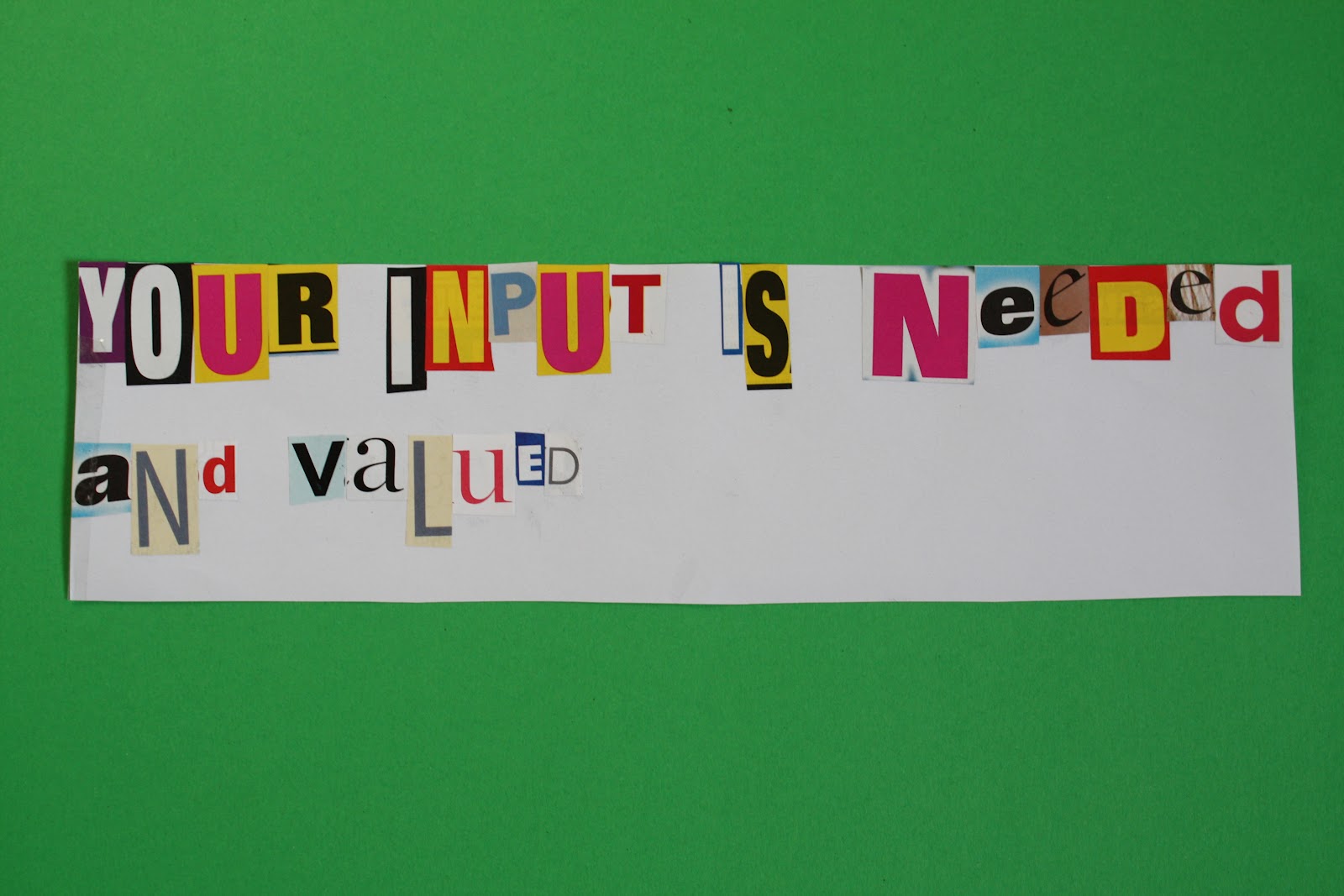
Your input is needed and valued


Manifesto Letter Collage by Piia Rossi

When the idea was circulated in the ‘Trailing Spouses' art group by Patty to think up a manifesto for our group, I was wary at first. As I had been unable to take part in so many meetings, I was wondering how much a part of the group I really was. I read up on the other ideas from the trailing spouses to see if I could get some inspiration. One manifesto idea was, Trailing Spouses are open to trying new things and going beyond their comfort zones. I must admit that I am not very good at trying new things. However, I definitely went beyond my comfort zone when I took part in a theatre workshop for the Trailing Spouses organised by member Coralie and her drama teacher, Rob. One exercise was called The Emotion Bus but it was more like a rollercoaster ride.  We each had to take a slip of paper with an emotion written on it, and to board “the bus” and approach the “bus driver” with that emotion in mind. I had the emotion “happy” and although happiness is a familiar emotion it is a different experience when you can go overboard and act ecstatically happy about something as banal as a bus ride, wax lyrical about the colour of the bus and how wonderful your bus driver is etc. There was also something karmic about the exercise as your emotion was mirrored and returned by the bus driver. In short, what you dished out, you got back in spades. As the bus filled up, we were supposed to mirror the boarding emotions, such as anger, fear, depression and love. Most of the time, I was just giggling at the back, but other times I felt genuinely swept up in whatever emotion was coming on the bus. One minute the bus was not going anywhere, because someone felt depressed and suddenly there didn’t seem much point any more, and the next we were heading off into a romantic sunset in a haze of hippy love.

It made me aware of the fact that people don’t display enough emotions in everyday life. Also, you might think the emotions most people are afraid of displaying are negative emotions, but actually I think people are even more afraid of looking happy in public here. As part of my research for my post “Old bag with school bag” I struck up conversation with someone working on the trams here on my journey home, and asked him why all the school children on the tram were heading home at midday. At first his face was a closed book, so closed it had one of those locks and keys I used to have on my diaries when I was twelve. Then the kinks appeared in his official demeanour. His mask melted, and lo and behold a human being appeared, and he actually looked relieved as a big smile enveloped his face. Perhaps only foreigners can get away with this, so I wouldn’t suggest everyone approach stony-faced officials on a whim.  But this brings me to another member's manifesto idea, Trailing Spouses value strength as much as vulnerability, emotions included.

I still can’t pin down exactly what the 'Trailing Spouses' art group is, but I see that as a good thing. Although it has a founding member, Piia Rossi, who is basing her PHD on the project, it seems to have a life of its own and is very democratic. When I think of a manifesto I tend to think of a narrow agenda, but apart from outlawing the “art police” as Piia puts it, there aren’t any rules as to what art can entail. In the group, art has been written, acted out, constructed and even baked.

Another manifesto idea was, Your input is needed and valued which I like because I felt it could be read several ways. Was the input needed and valued by the group or could the countries we find ourselves also value our input and even need us? Well, at least we can rely on the former, T.Ss!  There were lots of other manifesto ideas, but as it is still a work in progress, I haven’t mentioned them all here. And my manifesto idea?  We are not afraid of going off at a tangent.  No, hang on, that sounds more like a manifesto for my blog. Wait a minute, inspire, don’t perspire, no that is just plain silly. There goes the career as a political speechwriter. What about Trailing Spouses are not afraid to laugh at themselves? Is it a collective laugh, or laughing on an individual basis at oneself, but in a collective environment? Stop, just stop right there.


postscript: Just took a stroll through the town and was overwhelmed by cheery citizens of all ages, ready to strike up conversation with me and Henry, so maybe those grim countenances also have a lot to do with the long drawn out drizzly winters in Bielefeld. 


Wednesday, 15 February 2012

Eleven not 7


My 'Trailing Spouses' art group is a source of great inspiration. I don't know why I can't come up with any ideas myself for the group. I feel indebted at this point, but grateful.

Andrea suggested that we compose an "Elfchen"for our next group meeting, which is a bit like a German version of a Haiku poem. It has just eleven words, and has a fixed structure like the following

1: 1 word, - a  colour or a virtue
2 :2 words -  an object, theme, an issue or a person
3:3 words -  describes 2 in further detail
4:4 words -  your subjective viewpoint
5:1 word -   summarise

I wrote some Elfchen(s) in English first but then translated them into German. This was quite an interesting experience as the German version went beyond translation and I realised that another (more direct?) side comes out in me when I write German!

Patty suggested we confine the "Elfchens" to the theme of "Future". The future for me is too uncertain  to think about at the moment, I really don't know where I will be living in less than a year. I decided, though, to  preserve something from today for future reference. The banal moments and surroundings that you forget when you've moved house or  country. So the following "Elfchens" describe my home office at various points of the day.

I really like Andrea's idea of making the Elfchens into a three-way folding book. It will reveal the poems in an unexpected way, like the future does.


Green
Spider plant
Squats my desk
The Flower and the Carbuncle
hoping for green fingers 
Surviving.

yellow
A flower
drawn in crayon
appeared on my window
today

Silver
The computer
Showing Donald Duck,
laughing out loud at
failure

Grey
Courthouse opposite
Law against it?
Prince Charles would say
"Carbuncle"

White
A plastic bag
Left on floor
For how many months?
Three?


Grün           
"Flinker Heinrich*"
Ein illegaler Siedler
Nicht grüner Daumen Dank
Überlebend

Gelb
Eine Blume
Fenstergekritzeltes Gemälde, lebensbejahend
Die erschien gestern. Doch!
Heute

Grau
Landgericht gegenüber 
bricht jedes Gesetz
Prince Charles würde sagen
“Karbunkel”

Silber
Der Computer
Warum nicht die?
Gucken wir Donald Duck?
Nee

Weiss
Die schöne Tüte
Auf dem Boden
Einfach hingeschmissen, wie Schlampig!
Bitte?


*Apparantly a word for Grünlilie (Spider Plant), it's in the dictionary, honest!


                                                                                                                                                                                                             XES4N3QE69NW


Monday, 6 February 2012

Old bag with school bag


Last Thursday I took part in a self-portrait workshop run by Grace at the 'Trailing Spouses' Art Group. I had brought along my own props: a medium format camera and my son’s schoolbag, as I had an idea about how I wanted to portray myself. The camera represented my college days, and the dreams aspired to since that time towards some sort of career in photography. The school bag sums up my life as a mum, especially as I now carry it everyday for my son. Called a “Tornister”, nearly all German school kids have one. They are squarish, large and robust enough to sit on and you can choose from various themed designs. The thing is, it is so heavy, I end up carrying it for him. I always feel slightly preposterous walking down the road sporting a magenta striped rucksack emblazoned with footballers in mid-action, the straps squeezing my shoulders.
  
I merged the two portraits, to show that I find it hard to draw the line between these two images that reflect myself. Also, this lack of separation often leaves me feeling that I fall short in both respects, firstly as a mother and secondly as a creative and /or professional person.

 I read on the ‘used to be somebody’ by the journalist, Gaby Hinsliff, that she felt a kind of lifting of guilt associated with being a working mum when her child started primary school. She says …. it is the first time the choice - that terrible, double-edged choice - about whether to be home or not has been completely taken away from me.” In Germany, or at least where I live, there is still very much a choice about how long you leave your child in school. In the school where my son goes to, for example, the lessons start at 8:05 and sometimes finish as early as 11.50am. Then, some of the children are picked up for the day before lunch by their mums(or Dads perhaps), whilst others stay on in the after school care centre, which was founded just seven years ago, until 4.30pm at the latest. So that feeling of guilt is still in the air, when there are still two systems for the stay at home and working mums. This school system is changing in Germany, but there still isn’t one school here in Bielefeld offering the same school hours to all children, starting and finishing at the same time.

On occasion, I have picked up Eric before lunch and we have both really enjoyed the extra time together with my younger son Henry for the rest of the day. I am not actually supposed to pick him up before 2pm. Most of the time I pick him up between 3:00 and 4:00pm, like in the British system. Being self-employed, my workload is fragmented and I need to be able to work through to the afternoon on some days.

I do feel though it is strange, that in Germany you have to book a minimum of 45 hours a week of childcare for the under 3s in a kindergarten (9hrs a day!), which seems a lot, whereas when they go to school at the age of six, you may find the same child only being entitled to attend school for 4 hours a day. After school care is not free. It costs me 130 Euros a month including lunch, although if you have two or more children in a nursery or school, you just pay for the one child with the highest fees, which is good. 

Nevertheless, I do think it would be nice for the atmosphere of the school and the children if they could all be at school at the same time, and all enjoy the Karate, football or cooking clubs etc that are on offer  in the after school care centre. Socially, the school is also divided, for the parents and the children. Children who finish school before lunch are not allowed to use the playground in the afternoon because of insurance reasons. I obviously have more contact with parents whose children are in the after school care because I see them when I pick up my son. 

My experience is that many parents here don’t like the idea of comprehensive education, where lessons take place in the afternoon, because they believe it would be too inflexible and strenuous for the children. They prefer the model of lessons in the morning and an option of after school care in the afternoon, perhaps because of their own educational experience. My husband, for example, was at school from Mondays to Saturdays in the morning, but then he could run around unsupervised with siblings and friends for the rest of the day. I can’t imagine that happening these days. 

So I suppose I will have to get used to that portrait of myself for a while, and the choices associated with it.  In the meantime,  here is a picture of the "Tonni" in its full glory.  


Sunday, 15 January 2012

Home, a Mini-Saga


For the next 'Trailing Spouses' art group meeting, one of our members, Coralie, asked us to write a mini-saga, a story in exactly 50 words on the subject of Home, an emotive theme indeed, even for the most seasoned of Trailing Spouses. Here is my offering, covering the 3 places, and counting, which I call and have called home in my life. 


Going home to Berlin(where I lived for 11 years)

I went home and looked up at the plants on my balcony, strange objects. I looked over at the playground, children from my son’s kindergarten, new faces. A neighbour came to greet me like always. I looked at my front door. How strange to think that I cannot go inside. 


Going home to London where I lived from 0 – 29 years)

For my holidays I go home to London. I was born here. At St Pancras I buy a ticket and speak German! On the train, the familiarity of people takes me aback. A snippet of friends and family, that’s hardly enough. But better than Facebook and all of that stuff.


Going home in Bielefeld, Germany, where I have lived for 3,5 years.

I’m registered at this address, a German formality. Think of those who’ve stood at these windows before me! Who will move in? We move out, less than a year, possibly? View from my kitchen, a three hundred year old tree. Some people don’t appreciate it, blocks the light, you see.


Going home to Bielefeld, Germany (sometime in the future)


Seen through shop windows, fancy goods I could never afford. Outside the school, where Eric spent one year. One street of the square mile, walked again and again. The patisserie, they still know my name. Broken gate, lift it, feels the same. Ring the doorbell, old friends, ask me in.


Check out this mini saga on the theme of Home by Piia Rossi, which inspired me, on her blog, Trailingspousesdotcom.

Tuesday, 6 December 2011

Bumpety Bump rider


Illustration by Piia Rossi

For this week’s meeting of the Trailing Spouses Group, we were asked to look at the theme of frustration. I had written this post a while back with the spouses in mind, but frustratingly enough, could never seem to finish it. 

“Hoppe Hoppe Reiter” is a traditional German children’s nursery rhyme, which is as morbid as it is fascinating. Its verses tell the tale of a rider, and the various grim fates that could befall him. He could fall from his horse and what then? He could land in the swamp, give himself a scare by falling into the hedge or worse, be eaten up by ravens. It is a nursery rhyme that is full of what ifs?

Here is the original version :
Hoppe Hoppe Reiter
Wenn er fällt, dann Schreit er
Fällt er in die Graben
Fressen Ihn die Raben
Fällt er in den Sumpf
Macht der Reiter Plumps

And my rough translation

Bumpety Bump rider
If he falls, then he hollers
If he falls in the ditch
Then ravens will gobble him up
If he falls into a bog
Then he will land with a squelch

Bringing up children in Germany, this song has become more familiar to me than the nursery rhymes from my own childhood, and for my children it is certainly more culturally and linguistically relevant than “This is the way the lady rides”, for example. 

It is a “kniereitvers” which literally translated means, “ knee-ride-verse”, so the child sits on the knee, and at the conclusion of the song, the fall, you let the child “drop” between you knees. Children, of course, can’t get enough of it. They love the tummy turning thrill of being dropped, knowing that they will be caught before they really fall. 

For me, though, with its vivid descriptions of bumpy courses, pitfalls, failures and uncertainties, it strikes a chord.
I am not worried about being eaten by ravens when I step out of my front door, but, I still feel, after living in a foreign country for over ten years that I could easily fall on my face by saying the wrong word in German, cannot apply for a particular job because my qualifications are not recognised, and could offend someone by not addressing them formally enough. It probably won’t happen, it is probably just in my head, but it could. As the songs suggest, the dangers are ever present.

I looked up how other people had translated the song into English on the Internet.

What a difference there is between these three interpretations of the same line:
If he falls, then he shouts

If he falls he will be crying

If he falls, then he cries out

The first interpretation suggests defiance, the second defeat and the third a cry for help All valid responses to the topic of frustration and I have probably reacted in all three ways before!

When you come to a new country, I think the most frustrating thing to deal with is learning a new language. Even though I have been here for 10 years, I still need Klaus to check my emails and invoices for mistakes so that I feel I will be taken “seriously”.  I find this hugely frustrating to be dependent on another person in this way. It was my choice, though, to come to Germany but I can imagine the frustration of those who have come here for economic reasons or as a trailing spouse and are struggling to understand the basics.

In translation, there is an attempt to get close to the essence of the language. For me, this nursery rhyme serves as metaphor for the attempt to achieve closeness, not just to a language but also to a culture and way of life, and the pitfalls and possible frustrations that accompany it. But as the simple driving and repetitive tune implies, after falling on your face there’s no alternative but to get back up ‘on your horse’, even though you’ll likely be downed again at the next hurdle and so on, like a comical sketch.

If you can get over the frustration though, there are rewards.  Novels and music and nursery rhymes await you, and you can express some things in German that you can’t in English, which is why a lot of ex-pats speak Denglisch, a mixture of both. But for me, the litmus test of German proficiency is not at your local Goethe Institute but at your local bakery. These ladies guard their wares like linguistic sentries; any slip or wrongly pronounced nuance will be met by a merciless response.
“a what?” then a long protracted silence accompanied by a withering expression that quashes any confidence you ever had in your ability to speak German, even if you have lived there for half your life. This exchange can go on for ten minutes or more, as you are forced to repeat the same word over and over again in front of an ever growing queue of impatient customers, until begrudgingly the baker lady hands over your roll. Eat your heart out, Goethe (or your croissant), these are the true bastions of the German language.

Saturday, 24 September 2011

Trailing Spouse


 A few weeks ago, I was invited to join a PHD art project by and for “The Trailing Spouse” by my friend Piia Rossi.  This term describes the predicament we both find ourselves in, living in a place, which is not of our choosing where our partners happen to have work.   It is a term used often in the military, diplomatic or government circles, where the employee is relocated at regular intervals. It is also common practice in those areas to offer support in terms of jobs and childcare to the Trailing Spouse. In the States, universities are known to offer spouses employment in order to encourage academics to relocate. In the experience of Piia and myself, we have received no support from the University of Bielefeld: No Kindergarten place, no help in finding a flat and no support in finding a job.

The term “Trailing Spouse” is not empowering. Rather, it suggests weakness: A hapless soul trailing behind their partner, an appendage rather than an autonomous person.

To me, the words “Trailing Spouse” conjure up horticultural references. I imagine a delicate vine clinging on to a trellis, decorative and vulnerable to the elements. But to my mind, the “Trailing Spouse” must in actual fact become a very resilient type of plant.  It must survive being uprooted and replanted, it must be extremely adaptable to new conditions, it must find fertile soil or it will soon wither on the vine.

Piia was transplanted to Bielefeld over a year ago. Originally from Finnland, she lived in Ireland for twenty years as an artist printmaker and teacher before coming to Bielefeld.  In a way, it is a similar situation to me. She met her husband in the city that she chose to live in and then moved because of his job to a new town and became a “Trailing Spouse”. For her, though, the move was more extreme than mine as the country and the language was new to the family. Her husband is Slovakian, and her children speak English, Slovakian and Finnish and now German.

Before Piia explained her project to me, though, I had never really considered the notion of being a “Trailing Spouse”. 

She pointed out to me that it makes you different to the people you encounter in that place, not only because you may be foreign, but also because you don’t have the same relation to the place you happen to be living in, especially if that place is like Bielefeld, where many people who live here also grew up here. You will probably not have a steady career trajectory, as that would have meant staying in one place for a length of time or having your spouse following you. Your attitude to your flat will be different to most people, because you know that in a few years time you will be moving on, so there is no point investing that much in it.  In the back of your mind you know the friendships you make are, sadly, not going to exist in the same form in a few years time. Somehow, this makes your status quite different to others, even taking into consideration other life altering changes that effect everyone.

So I was pleased when Piia told me about her great project and even invited me to join it. It has promised me a sense of belonging and that, ironically, because of my “Trailing Spouse” status, which usually set me apart.  And I realised, that even though I have been in Bielefeld three years and will most probably move somewhere else in one year I have, despite being a “Trailing Spouse”, made some kind of headway here. I have had new experiences that I wouldn’t have had if I had stayed in Berlin. I have joined a brass band and go to a book club, and have met brilliant people here as well as finding out about another little corner of the globe and I suppose, another side of myself. 


You can view Piia Rossi's "Trailing Spouses" community page, which is on Facebook, to find out more information.