Showing posts with label urban. Show all posts

Sunday, 9 April 2017

So long, and thanks for all the fish

I walked into the Tate to see a member of staff holding an inflatable fish. 


This was after seeing a striped man trying to outdo St Paul's with his pointy hat.


At first sight unsettling, this image is benign: people enjoying merging and emerging from the water spray installation outside the Tate

These workmen at the Tate are responsible for your Seele (German word for soul). However, they are not buying at the moment. I tried. 


When you step inside, the 'book' is in fact a video installation showing unpublished photos of built spaces: urban, corporate, detailed. mundane, and epic side by side. In short, wonderful and insightful. This part of Tillman's show is off the turbine Hall and as far as I know this part is free entry. 


The former power station supports life: a bush. Actually, Peregrine Falcons have been spotted hunting pigeons from the tower.


you know it is a good show when the staff are still enjoying it

A surreal part of the day, seeing Wolfgang Tillmans in person who kindly signed the catalogue for me.


Perhaps the best slogan of all time?


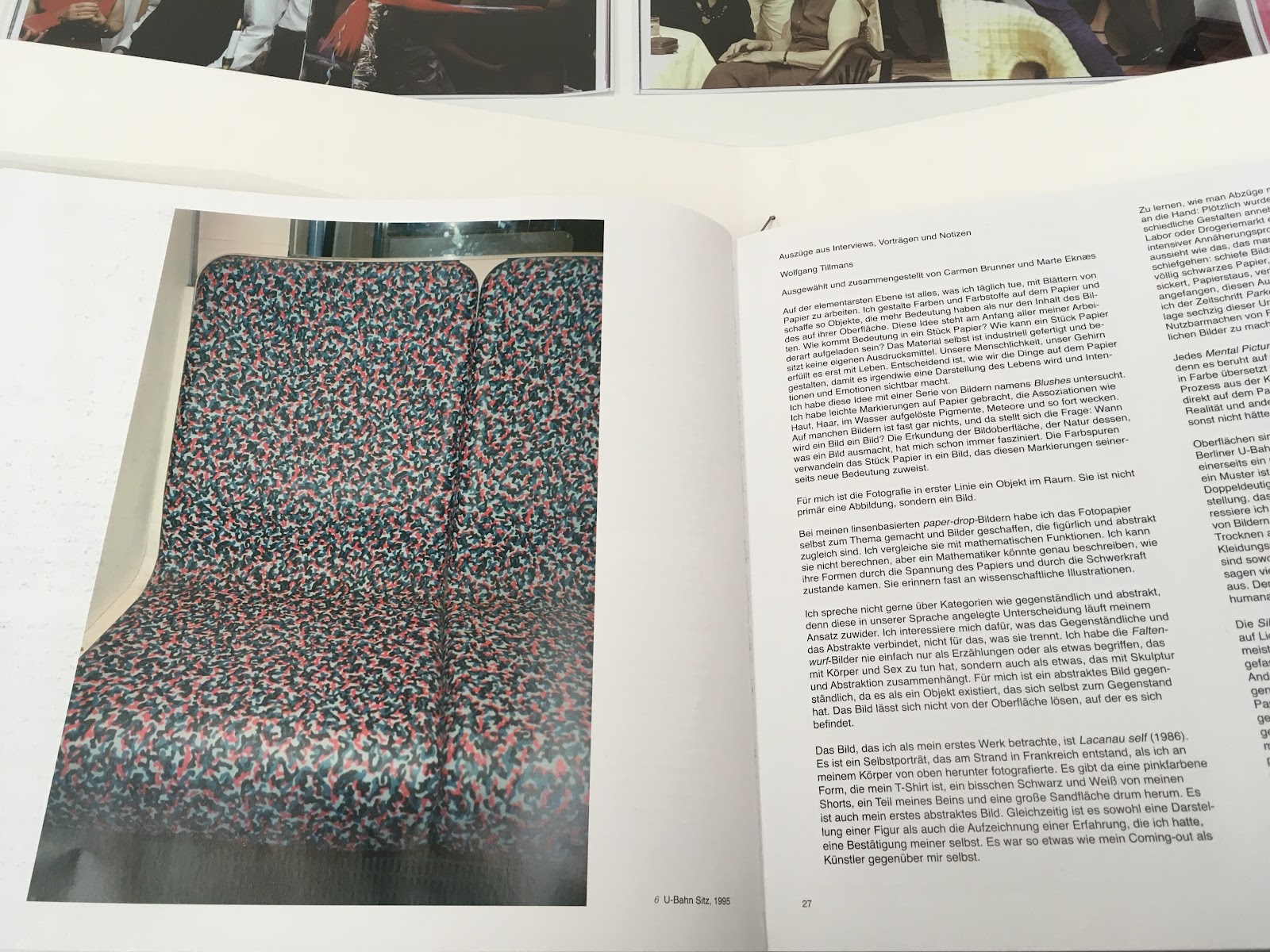
 Scorched earth policy applied to design - Berliner U -Bahn seating


I obviously came late to the inflatable fish party: The Tate roof.


This aerial image is like a map of somewhere else
Canary Wharf. When you know the formative structure of the building is going to be more interesting looking than the building itself


Saturday, 9 July 2016

Love is a Birch


The photos above are of  "Maibäume", or "May trees" in Cologne. Traditionally on the night of the 31st April to the 1st May, young men would go out to the forest and find a birchtree, chop it down and decorate it with ribbons and a "May-heart" with the name of the girl he favoured on it. He would then put the tree up in front of her house to show his intentions.

Nowadays, the tradition continues, but it is illegal, in Cologne anyway, to just take birch trees from the forest. Now you are supposed to buy them from an official seller and can even get them delivered, erected and taken down by a "Maibaum-Taxi" service for a price, which doesn't sound quite so romantic.*

This being Cologne, home of the Carnival, there have been known to be shenanigens in the night to 1st May. Maibaums have been known to disappear in the night only to appear in front of another girl's house, the heart inexpertly replaced and another name scribbled on in Edding marker. An unguarded May tree on this night may be seen as fair game. The adventure of finding and putting up the tree is by tradition something you do with your friends. Defending or trying to steal another tree into the early hours just as much a part of it. To steal a tree after the 1st, is seen as poor taste.

The trees are supposed to be taken down by the 31st May, and in return for their efforts the boys (or on leap years, girls) receive a crate of beer and perhaps a kiss or an invitation to dinner.

In July then, when I visited my friends, I was surprised to see the Maibäume still hanging in there on the lamposts and guttering two months later. Were they still there to bring a bit of colour to the otherwise drab facades? Or were they abandoned by some spurned suitor? Were the owners simply "Angeber" or "show-offs", as one friend put it? All the green leaves, symbols of youth, Spring and renewal were long gone, the coloured crepe ribbons tangled and wind-swept. One heart devoted to "Maria" stood more like a paean to love lost, illusions stripped bare just like the brittle dead branches surrounding it.

Or perhaps the story is not so tragic. Maybe the Maibäume are still in bloom on social media, and can wither and overstay their welcome on the street. There is no need to take them down in "real life", as it is already out there forever.

Instead you can post clinking Emoji beer mugs as a reward (forget real beer crates) on Facebook and receive likes from your beloved (and his friends) in a new tradition of self-endorsement and mutual appreciation ad infinitum. Meanwhile the aging Maibaum, erstwhile a symbol of fertility, still clings to the guttering, now a reminder of youth and love's folly in the face of time.

Of course I have no idea why the Maibäume were still there, and it probably doesn't matter why. Though I am glad that they were. Otherwise I could never have photographed the Maibäume that shouldn't have been there on an overcast first day of July.  And found out what I probably knew all along; that love can be a real birch.


* I checked out the Maibäume-Taxi service  in case you might find yourself wooing a sweetheart in Cologne one of these days. It has ten options on offer, starting from 40€ up to 180€. Here is model 5:

"Tree option 5 for €100: Take advantage of the all-inclusive service and have a colourfully decorated Maytree complete with heart delivered to the address of your choice. There in the night to 1 May it will be put up between 20:00 and 07:00 and at the end of the month (at the latest 1 week of June) it will be picked up and disposed of. You will be notified by text message when the tree has been put up. You don't have to do anything. By special request you can have tree 5 with white/red crepe ribbon in Cologne 'look' / FC Köln club colours, or Düsseldorf 'look'."

Saturday, 23 April 2016

The Photo Opportunist


I read another article recently bemoaning that people were taking so many photos of their lives on their mobiles that they were missing out on the 'real experiences', and even less likely to remember them afterwards.

Maybe we are not missing out on a real "experience", if there is such a thing. Perhaps we can also discover an "experience" or even an "existence" through taking photos. The Japanese photographer Gentaro Ishizuka puts it like this in the notes to one of his books, 'Lensman':" In this world of unstoppable time, where no one can grasp anything in its entirety, it may be entirely possible that the reality of these things captured by the camera in pictures, could, in fact, trump one's own reality".

I like Ishizuka's metaphysical approach to photography because it is visually very much grounded in the sober and everyday. He seems, like me, to be a photo opportunist, at least for this project: "My next theme will be things that simply catch my eye when going out for no particular reason, or just everyday things".

He is also conscious of the fact that no matter where he is, he experiences a kind of "déjà vu" with his pictures. "Finally, after this remote journey following the Pipeline (in the Arctic) to its most distant point, I had once again found that scrap factory on Harumi Pier". He goes on: "...perhaps all these things were simply images pulled from one's own consciousness".

From the book "Lensman" by Gentaro Ishizuka


Fascinated by junk that he had discovered in a disused factory there many years before, Ishizuka adds,"Bathed in the faint light seeping through the walls, these discarded radios, television, and other miscellany took on new meaning with a multitude of shapes, shadows and substance. And in that place without a soul, taking pictures in deep meditation, there was oneself". 

And I would add, that as much as there is "oneself" in such places, there is also the "not oneself". The void, the blindspot of the self. This in turn may lend even the most empty of places a soul. Even if we can't see the blindspot, we can try and depict it, experience it. As in Ishizuka's photograph above, we can't see our own backs but it is still an interesting view. 


This piece was inspired by the artist book meet-up in Edinburgh that takes place once a month. 

(The pictures were taken at Fountainbridge in Edinburgh on the site of a former brewery. The Grove is a community garden project also at Fountainbridge. At "The Forge" people can learn carpentry and welding skills in workshops held in shipping containers. The new Boroughmuir High School is also being built there.) Here are some pictures of the same site from two years ago.


Sunday, 27 March 2016

Seismic Lewisham: A work in progress


I was born in Lewisham. As long as I can remember, the centre of Lewisham in South East London has always been rather a work in progress, dominated as it is by a massive roundabout, the high road flanked by an enormous police station (the biggest in Europe!) and an ageing shopping centre. With the link of the DLR to Canary Wharf and Bank there has been a lot of building work here in the last five years in the centre. With so much development in London recently it would be interesting to imagine that the original characters of districts to be seismic rather than down to the economic whims of the day. If it were seismic then the character and history beneath it would always bubble through and burst the attempts to lay order upon it, whatever facade was slapped upon it or soul ripped out of it by a property developer. Covent Garden and Soho, for example, would remain  'louche', erupting periodically to reset itself despite attempts to tame it. Lewisham's seismic nature would always be that of a 'work in process'. It would always teeter towards ugliness but there would always be the underlying hope for the beautiful Lewisham of tomorrow.