Showing posts with label catalogue. Show all posts

Thursday, 29 October 2015

Mel Gibson's Legs


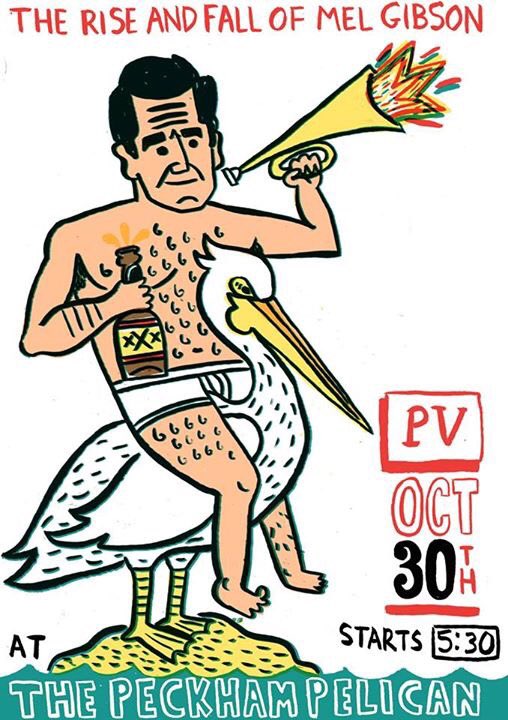
Akin to hiring the least qualified and unsuitable candidate for a job, illustrator ZEEL invited me to write a piece for the book accompanying the upcoming illustration exhibition The Rise and Fall of Mel Gibson. Least qualified as I had never even seen a Mel Gibson film before ZEEL asked me. Under strict laboratory conditions then, with my hand hovering over a red alarm button in case of emergency,  I was exposed to the film What Women Want, an American Romantic Comedy from the year 2000. How a Norwegian fisheries scientist/ film buff got into the mix, I don't know.
The flyer is designed by Aidan Saunders, who organised the exhibition together with ZEEL.


Mel Gibson’s legs

I’ve come to Norway to do some research into Mel Gibson and his seminal film, What Women Want. Although the film came out in 2000, and was quite popular in Norway that year, incredibly, fifteen years later, it is still the highest grossing film here. At the Oslo Film Foundation, recent research has revealed that the average Norwegian has seen the film 13.3 times.

Sometimes films get lost in translation when they cross the Atlantic, but in this case the film bound for Norway was actually lost. Ragnar Holst Sørland, a fisheries scientist, was given the task of importing What Women Want. He had made a series of highly successful films of fish for television. In Norway people love to see slow, contempletive films of trains going from one side of the country to another, for example, or rain pattering on a corrugated iron roof, or twitching curtains, all in real time. The trouble was after Sørland’s astoundingly low key film Fish Sleep Too the genre seemed to be exhausted.

But what does all this have to do with What Women Want, a film about a chauvinistic advertising executive, played by Mel Gibson, who electrocutes himself in the bath and suddenly is gifted with the ability to hear women’s thoughts? Surely that couldn’t be boring? It’s true, Sørland was pretty disappointed when he saw this film. He had never done product placement, but this film was practically an advertisement for Nike. They even had Nike executives play themselves in a key pivotal scene. He didn’t like scenes with pivots either. The protagonists in his film were fish of the most easy going nature, so would blow any rampant egotistic alpha male like Gibson out of the water.
As he sat through the film in Gibson’s own private screening room in LA, he had to stifle yawns. In one scene, Gibson was supposed to be sampling products aimed at women such as lipstick, leg wax, and mascara, to get insight for a pitch to his advertising boss the next day. Instead of putting his mind to it, he wastes his time drinking red wine and dancing around his apartment to Frank Sinatra. He even rips a decent pair of tights. Ragnar tries to understand the premise of the film. Why doesn’t Nick Marshall respect and understand women in the first place? Why does he find having a female boss a problem? Don’t they have a women’s quota?

After turning down Gibson’s offer of a part in his latest movie as a Norwegian fisheries scientist, Ragnar makes his excuses and leaves with Sinatra still ringing in his ears. Gibson’s film stinks like Surstrømming, but Ragnar has the film board to answer to. Ragnar comes to a decision. “I’ll do it ‘My Way”, he says. “Not for me though. For my fellow citizens.”

On the ship back to Norway, Ragnar has just six months to rework the film. In his tiny cabin he works with scissors and glue, cellophane and burned matchstick heads to recreate a film that could just merit his journey. After four months he pauses to look out the porthole, then resumes his work. 

The Oslo Film Foundation screens What Women Want. It is a 24 hour frame by frame version of the scene in which Mel Gibson waxes his right leg. The part that Ragnar finds particularly successful is the four hour scene of the wax heating up in the sink in its little tub. How that scene was wasted before in a matter of a second? The scream Gibson emits when ripping off the wax strip now has a spiritual quality. Slowed down, it is hard to tell if there is really one tone or more, but at times it sounds like a Mongolian throat singer, uplifting.

Pleased with his work, he decides to set off on a vanity project, ‘sink or sink’, a film about a carp's journey to the bottom of a pond. He has also made a friend across the pond. Mel Gibson has agreed to introduce him to a friend or two in Hollywood. Maybe they will knock out some slo-mo films together, as Mel calls them. They even have a working title: What Fish Want. 
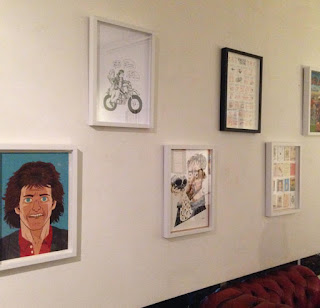


by ZEEL


A video of a flick through preview of book:


Sunday, 16 November 2014

Narrative Takes: More Pictures in the World...


This is part one of a talk I gave at the Democratic Photo Club held at Stills Gallery in Edinburgh on November 6th. Members are invited to set a theme for others to interpret through photography with a talk, discussion and show of members work. For November I chose the theme of NARRATIVE TAKES and was interested in artists who create tensions between reality and fiction in their work challenging our conventional scripts. To introduce the theme I told two stories of my own inspired by the artist Thomas Demand. Here is the first story including a short intro on Thomas Demand.


I first saw the work of Thomas Demand at the Serpentine Gallery in 2006. Living in Berlin at the time, the fact that he was German and living and working there and of my generation were other factors that attracted me to seeing the show. Apart from that, London is my hometown and a gallery visit was a way for my Dad and I to spend time together, to structure and frame our somewhat difficult relationship. On a basic level it was something to do.
Staircase, 1995, C-Print/Diasec, 150 x 118 cm


When you first see a work by Thomas Demand, you may think it is a straight photograph of a scene or interior. As sources for his ideas he uses found or archive photographs and also personal memories. He constructs a life size model from paper and card which he then photographs again. After the photo is taken, the model is destroyed. It is only when you look closely that you realise the deception, that the photograph is lacking certain details or appears too perfect.

Klause/ Tavern 2, 2006, C-Print/ Diasec, 178 x 244 cm

You naturally begin to create a narrative from your own associations with the place/image in front of you. But even when you know the  story behind the image if there is one at all, you realise the world Demand has created doesn't exist, that it is fake and constructed. How reliable then are the narratives you choose in your everyday life and the ones you see in the media?

Office, 1995, C-Print/Diasec, 183.5 x 240 cm
When we arrived at the Serpentine, we saw that the walls of the gallery were covered in hand-blocked ivy themed wallpaper, in four colour tones to reflect different times of day. Normally you would expect art photography to be placed on a white wall. There appeared to be a deliberately stark contrast between the handicraft of the wallpaper and the apparent slickness displayed in the large photographic images.
Installation view, Serpentine Gallery, 2006 by Nic Tenwiggenborn


Copyshop 1999, C-Print/Diasec 183.5x 300cm


A 3 metre wide photograph in the exhibition called 'Copyshop' shows at first sight that: A ubiquitous space filled with photocopiers. There are no logos on the machines or paper. An impersonal space has been further stripped of clues. The photographic image of a photocopy room would appear to be the very antithesis of the process of handicrafts. Infact, by using the same material as a photocopier, paper, to make the somewhat banal scene in front of us Demand raises questions of reproduction, originality and the intrinsic worth of objects and images themselves. It is in itself a narrative that resounds through the gallery space, partly absorbed by the textured wallpaper, bouncing lightly off the glass surface of the photographs until it reaches us, where it will fall upon us to listen to our associations with the spaces that no longer exist or perhaps only once existed as an idea in paper that Demand once created. 


Hand-Blocked Wallpaper from the exhibition


After the show, I wanted to buy a book on Demand’s work. A disagreement began between my Dad and I about buying the show’s catalogue. My Dad thought it was too expensive and bought me another Demand book from a past exhibition:


 We had even walked away from the Serpentine  into Kensington Gardens and along the lake when I realised I really really wanted the exhibition catalogue as well as or instead of the other book. I was an adult but also the spoilt little girl with her Dad who felt she had to get what she wanted. Sometimes I hate this trait of mine, I get seduced by an exhibition and feel I must have “it”, whatever that thing is. I guess I am not alone in this as I have noticed the gift shops getting bigger in relation to art galleries and museums spaces. Anyway, I convinced myself that I couldn’t live without this catalogue, as it had pieces of the original wallpaper stitched into the book and was of the exhibition I had actually seen. Why couldn’t just seeing the exhibition be enough? I got my way, and we headed back and soon the issue of money seemed to loom up large between us. I felt embarrassed now as it turned out my Dad had only wanted to buy me something and he had. I also felt his dissaproval keenly that I wanted to spend more money which we both knew I didn’t really have on something that was in his eyes - unneccessary.

 In the midst of our discussion on the gallery steps, a man approached us and said he was a patron of the Serpentine and as such could get us a discount on the catalogue. (We must have been attracting attention). He accompanied me to the sales desk and I bought a catalogue for myself that my Dad still thought was too expensive even with a discount and was more expensive than the one he had bought for me.

It seems so poignant to me that this personal narrative has formed alongside the many narratives of the exhibition itself.

Now turning the pages of the book eight years later I see that the back of one piece of wallpaper has tiny circular ink flecks and mottling soaked through from the front of the paper itself.


This is echoed on the next page in “Constellation” an image of how the night sky would appear exactly 300 years into the future.
Constellation 2000, C-Print/Diasec, 130 x180
With this photograph, Demand defies the logics of photography that it is supposedly telling us a narrative that is always about the past. At every new exhibition space he reconfigures the image again so that it creates an image at that space exactly 300 years into the future. 

Images, whether taken by us or present in the media become part of the landscape of our past. Thomas Demand literally punches holes in paper to make this photograph of the night sky and in doing so he also punctures the façade of these narratives. A projected constellation of the skies has no stories only the ones we choose to project upon it. I see this photograph as something wholly unemotional. I think that is what Thomas Demand does with the photographs and constructions that he makes. He takes out the detail, creates a certain vacuum lacking in emotion. In doing so he reflects upon and lays bare our own personal and cultural associations and ironically, emotions.

Again, there is a twist to the story of this photograph. We are not seeing an image of the future at all but one of the past. The projected constellation is of light travelling towards us is from a million years ago due to the speed of light. We are not dealing with nice human distances of miles and kilometres either, or digestable human nuggets of time we frame our small stories within. Therefore to project any sentimentality, emotion or stories onto it is absurd.  Still, we do it.

I am writing this about eight years after visiting the Serpentine Gallery with my Dad. I can still touch and look through the catalogue in front of me. I am glad I bought it, as it brings back happy memories as well as being a beautiful object. This is even as I recollect with a certain embarrassment the situation under which the catalogue was purchased. This small story echoes many other stories that played out between my Dad and I, each incident not allowed to be isolated or played out alone but heavily loaded just like a Demand photograph. Now, just eight years later, a small human scale of time, I can only remember my Dad through the photographs and memories I have of him, and now this story.


(More images and information  on Thomas Demand available on his website)